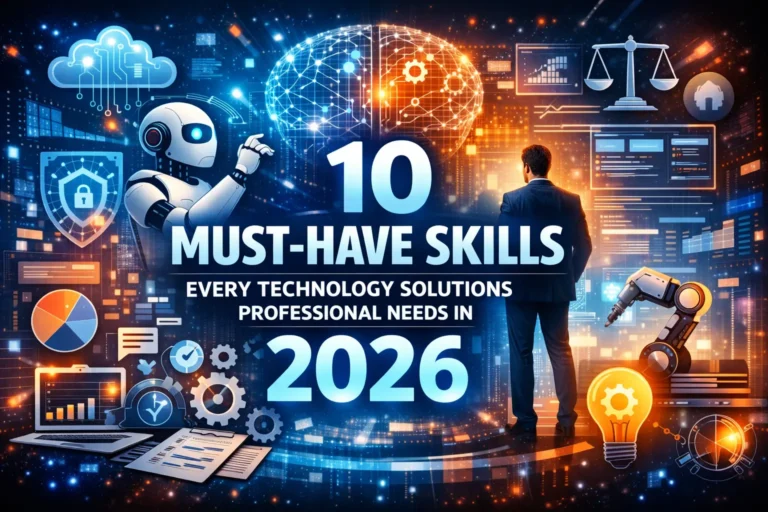
Technology solutions professional sit at the center of modern business. They connect strategy, software, security, and people. In 2026, that role grows even more critical as AI, automation, and cloud platforms reshape how organizations operate.
This guide explains the 10 essential skills you must build to stay relevant, trusted, and future-ready.
Each section stays grounded in widely accepted industry practices and guidance from major technology ecosystems and professional standards bodies.
Why Skills Matter More Than Technology solutions professional in 2026
Job titles change quickly. Real capability lasts.
Organizations now hire for adaptability, problem-solving, and cross-functional thinking, not just certifications. Research from global cloud and enterprise platforms consistently shows that hybrid technical-business talent delivers the strongest results.
In simple terms:
Knowing tools is helpful.
Solving business problems with those tools is priceless.
Let’s explore the skills that truly matter.
1. AI-Augmented Problem Solving
AI no longer sits in the background. It shapes workflows, customer support, analytics, and software development.
Technology solutions professionals must:
- Understand how AI models assist decision-making
- Evaluate outputs for bias, risk, and accuracy
- Combine human judgment with automation
Enterprise guidance from platforms like Microsoft and Google Cloud emphasizes responsible AI use, transparency, and governance.
Reality check with humour
If AI gives a perfect answer in one second…
you should still spend ten seconds checking it.
That ten seconds protects your job.
2. Cloud Architecture Literacy
Cloud skills remain foundational in 2026.
But the expectation has changed.
You no longer need to configure every server manually.
You must design scalable, secure, cost-efficient systems.
Core knowledge areas include:
- Multi-cloud and hybrid environments
- Cost optimization strategies
- Resilience and disaster recovery
- Identity and access management
Major providers like Amazon Web Services continue to stress architecture best practices rather than tool memorization.
Think of cloud literacy as learning city planning, not just building houses.
3. Cybersecurity Awareness for Everyone
Cybersecurity no longer belongs only to security teams.
Every technology decision now carries risk implications.
Essential competencies:
- Zero-trust security concepts
- Secure configuration and patching
- Data privacy fundamentals
- Incident response collaboration
Global cybersecurity frameworks consistently highlight human error as a leading cause of breaches.
That means your awareness directly protects the organization.
A useful mindset:
If your system connects to the internet,
assume someone somewhere is already curious about it.
4. Data Thinking, Not Just Data Tools
Many professionals learn dashboards.
Fewer learn how to think with data.
In 2026, valuable professionals:
- Ask the right analytical questions
- Validate data quality and bias
- Translate insights into business actions
- Communicate findings clearly
Guidance from analytics leaders across the industry shows that decision impact matters more than chart design.
Beautiful graphs are nice.
Correct decisions are better.
5. Automation and Workflow Design
Automation saves time, reduces error, and improves consistency.
But random automation creates chaos.
Strong professionals focus on:
- Process mapping before automation
- Low-code and no-code orchestration
- Monitoring and rollback planning
- Measuring real efficiency gains
Industry automation studies repeatedly show that poorly designed automation can increase complexity instead of reducing it.
So remember:
If automation makes things confusing…
it is not automation.
It is decoration.
6. Communication Between Technical and Business Teams
This skill quietly determines career growth.
Organizations value professionals who can:
- Explain technical risk in plain language
- Align solutions with business outcomes
- Lead cross-functional conversations
- Document decisions clearly
Many enterprise transformation reports identify communication gaps as a major failure point in digital projects.
In other words:
The smartest solution fails
if nobody understands why it matters.
7. Agile and Adaptive Project Thinking
Rigid planning struggles in fast-moving environments.
Modern delivery models emphasize:
- Iteration instead of perfection
- Continuous feedback
- Measurable outcomes
- Rapid adjustment to change
Agile frameworks continue to influence enterprise delivery because they reduce large-scale failure risk.
A practical truth:
Shipping a useful version today
beats promising a perfect version next year.
8. Ethical Technology Judgment
Ethics now sits at the center of technology decisions.
Professionals must evaluate:
- AI fairness and bias
- Data privacy and consent
- Environmental impact of computing
- Transparency in automation
Global policy discussions and corporate governance models increasingly require ethical review in digital initiatives.
This skill protects:
- Users
- Organizations
- Your professional reputation
And reputation, unlike software, has no easy patch update.
9. Continuous Learning Systems
Technology evolves faster than any curriculum.
Successful professionals build learning habits, not just knowledge.
Effective strategies include:
- Structured certification paths
- Hands-on experimentation
- Community knowledge sharing
- Tracking industry standards
Major technology ecosystems consistently highlight lifelong learning as the strongest predictor of career resilience.
The rule for 2026:
Your current skillset is temporary.
Your ability to learn is permanent.
10. Strategic Business Understanding
The final skill ties everything together.
Technology solutions professionals must understand:
- Revenue models
- Operational efficiency
- Customer experience
- Competitive positioning
Executives invest in technology only when it drives measurable value.
So the real question behind every project becomes:
How does this improve the business?
If you can answer that clearly,
your career path becomes much easier.
How These Skills Work Together
Individually, each skill helps.
Together, they create true Technology solutions professional leadership.
A 2026 ready professional can:
- Use AI responsibly
- Design secure cloud solutions
- Interpret data for decisions
- Automate wisely
- Communicate across teams
- Deliver value continuously
This combination defines the modern technology solutions professional.
Video Source
Final Thoughts
Technology keeps advancing.
But one truth remains constant:
Human judgment drives meaningful outcomes.
Tools will change.
Platforms will evolve.
Buzzwords will come and go.
Yet organizations will always need professionals who can:
- Think clearly
- act responsibly
- communicate simply
- and solve real problems
If you build the ten skills in this guide,
you will not just survive 2026.
You will lead it.