
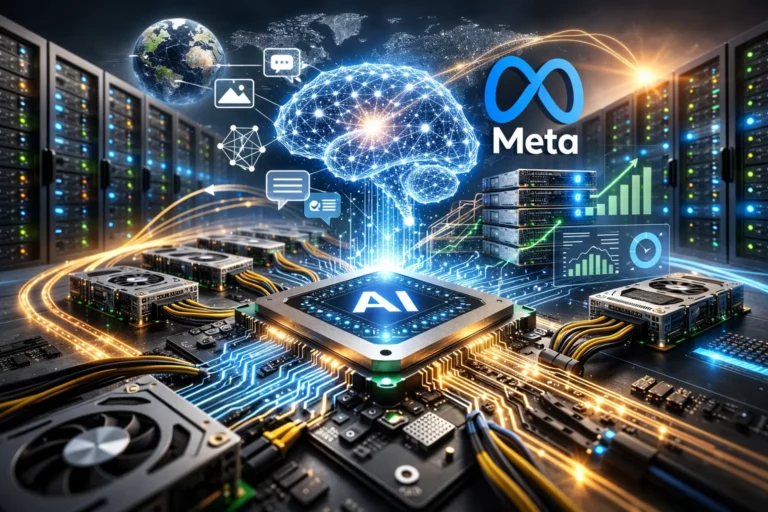
The long-term agreement between Nvidia and Meta underscores accelerating global demand for AI infrastructure, strengthening Nvidia’s dominance in advanced semiconductors while fueling Meta’s next phase of AI-driven products and services.
Table of Contents
Introduction: Who, What, When, Where, Why, and How
Who: Nvidia and Meta Platforms
What: A multiyear agreement under which Nvidia will sell millions of advanced AI chips to Meta
When: The deal spans several years beginning in 2026, according to company disclosures
Where: The chips will be deployed primarily in Meta’s global data centers across North America and other regions
Why: To power Meta’s expanding artificial intelligence initiatives, including generative AI, recommendation systems, and next-generation computing infrastructure
How: Through large-scale procurement of Nvidia’s high-performance AI accelerators and networking technologies, integrated into Meta’s growing data center footprint
In a move that reinforces the central role of advanced semiconductors in the global AI race, Nvidia has entered into a multiyear agreement to supply Meta with millions of AI chips. The deal highlights surging demand for computing power as technology companies scale artificial intelligence systems across consumer platforms, enterprise tools, and cloud services.
While financial terms were not publicly disclosed, the scope of the agreement signals one of the most substantial chip procurement commitments in the AI era.
A Strategic Partnership in the AI Boom
The partnership reflects a broader industry shift: artificial intelligence has become foundational infrastructure rather than an experimental technology.
Meta has steadily expanded its AI investments to support products across its family of apps, including Facebook, Instagram, WhatsApp, and Threads. The company has also intensified development of generative AI tools, large language models, and recommendation systems that rely heavily on high-performance GPUs (graphics processing units).
Nvidia, meanwhile, has emerged as the dominant supplier of AI accelerators. Its data center GPUs are widely used to train and run large AI models due to their parallel processing capabilities and specialized architecture.
Industry analysts have noted that major cloud providers and tech giants continue to compete aggressively for access to Nvidia’s most advanced chips, as supply constraints have shaped the market over the past several years.
Why Meta Needs Millions of AI Chips

Artificial intelligence workloads demand immense computational capacity. Training large-scale models requires clusters of thousands sometimes tens of thousands of GPUs operating in parallel. Running these systems for billions of users further multiplies the hardware requirement.
Meta has publicly outlined plans to increase capital expenditures significantly to expand AI infrastructure. Company executives have emphasized building one of the largest AI compute fleets globally to support:
- Large language models
- AI-powered content recommendations
- Advanced advertising optimization
- Generative AI assistants
- Research into open AI systems
Executives have previously stated that AI will underpin nearly every aspect of Meta’s product ecosystem, from personalized feeds to immersive digital experiences.
By securing millions of chips through a multiyear deal, Meta reduces procurement uncertainty and positions itself for long-term scaling.
Nvidia’s Expanding Data Center Dominance
For Nvidia, the agreement further strengthens its leadership in AI hardware.
Over the past few years, Nvidia’s data center business has outpaced its traditional gaming segment, reflecting the global shift toward AI infrastructure. Its high-performance GPUs and networking technologies have become essential tools for companies building AI at scale.
The demand surge has elevated Nvidia’s market valuation and revenue growth, with AI data center sales accounting for a substantial portion of its financial performance.
The multiyear Meta agreement reinforces the company’s long-term order visibility and demonstrates sustained demand from hyperscale customers.
Data Centers: The Physical Backbone of AI
Behind every AI model lies vast physical infrastructure.
Meta operates data centers across the United States and internationally. These facilities house tens of thousands of servers equipped with advanced GPUs and high-speed networking systems.
Expanding AI workloads requires:
- Increased power capacity
- Advanced cooling systems
- Optimized networking architectures
- Supply chain coordination
Data center expansion has become a central focus for technology firms. Governments and regulators have also begun monitoring energy consumption and sustainability practices tied to AI growth.
The Nvidia-Meta deal underscores how AI innovation now depends not only on software breakthroughs but also on hardware scale and infrastructure planning.
Competitive Landscape: Big Tech’s AI Arms Race
Meta is not alone in scaling AI hardware investments. Other major technology companies have significantly increased chip purchases to support generative AI and cloud-based AI services.
The race involves:
- Securing long-term chip supply
- Designing proprietary AI chips
- Expanding data center footprints
- Investing in networking and storage technologies
However, Nvidia remains a critical supplier even for companies developing custom silicon. Its ecosystem of software tools and developer platforms strengthens its position in the market.
The multiyear deal suggests Meta continues to rely heavily on Nvidia’s architecture for both training and inference workloads.
Supply Chain and Geopolitical Context
Global semiconductor supply chains have faced disruptions in recent years due to geopolitical tensions, export controls, and manufacturing bottlenecks.
Advanced AI chips often require cutting-edge fabrication processes and specialized manufacturing facilities. Export restrictions on certain high-performance semiconductors have also influenced how companies allocate supply across regions.
Large, long-term agreements such as this one help stabilize procurement planning and mitigate supply uncertainty.
Industry observers note that long-term chip deals increasingly function as strategic alliances rather than simple supplier contracts.
Financial and Market Implications
Although neither company disclosed the total value of the agreement, analysts view such multiyear chip commitments as potentially worth billions of dollars over time, depending on volume and product mix.
For Nvidia, large-scale agreements:
- Provide revenue visibility
- Strengthen investor confidence
- Support production planning
For Meta, long-term supply deals:
- Lock in access to critical hardware
- Reduce short-term market exposure
- Enable predictable infrastructure expansion
Markets have closely tracked AI capital expenditure trends, viewing hardware investments as indicators of competitive positioning in the AI economy.
Sustainability and Energy Considerations
AI infrastructure expansion brings environmental considerations to the forefront.
Data centers consume significant electricity, particularly when running large GPU clusters. Companies including Meta have publicly committed to renewable energy sourcing and improved efficiency standards.
Energy efficiency, cooling innovation, and carbon reduction targets remain central to scaling AI responsibly.
As AI workloads grow, balancing technological advancement with sustainability commitments will remain an industry challenge.
Expert Perspective: AI Infrastructure as Strategic Asset
Industry experts increasingly describe AI computing power as a strategic asset comparable to cloud infrastructure during the early 2010s.
High-performance chips are now foundational to:
- Generative AI development
- Advanced analytics
- Robotics research
- Virtual and augmented reality applications
Securing millions of chips through a multiyear agreement signals Meta’s intention to remain competitive in both consumer AI applications and long-term research initiatives.
What This Means for the Broader AI Ecosystem
The Nvidia–Meta deal reflects a structural shift in the technology sector:
- AI hardware demand remains strong.
- Long-term procurement strategies are replacing short-term purchases.
- Infrastructure scale determines competitive advantage.
The agreement also reinforces Nvidia’s role at the center of AI infrastructure globally.
As companies integrate AI deeper into consumer products and enterprise platforms, chip supply agreements may increasingly shape the pace of innovation.
Video Source
Conclusion: A Defining Infrastructure Bet for the AI Era
Nvidia’s multiyear agreement to sell millions of AI chips to Meta represents more than a commercial transaction. It highlights the scale, urgency, and strategic importance of artificial intelligence infrastructure in today’s technology landscape.
For Meta, the deal secures the computing power needed to expand AI-driven services across its platforms. For Nvidia, it cements its position as a foundational supplier in the AI economy.
As AI adoption accelerates worldwide, long-term chip partnerships such as this one will likely play a decisive role in shaping innovation, competition, and digital transformation for years to come.