
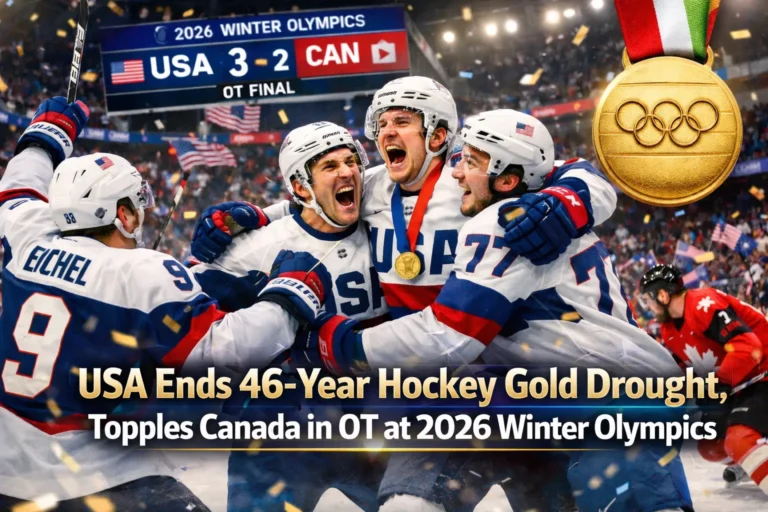
The United States ended a 46-year Olympic men’s hockey gold medal drought with a dramatic overtime victory over Canada at the 2026 Winter Olympics, delivering one of the most memorable finishes in modern Games history.
The gold medal match, held during the Milan-Cortina 2026 Winter Olympics in Italy, saw Team USA defeat its longtime rival in sudden-death overtime, reclaiming the top podium spot for the first time since the 1980 Lake Placid Games. The win not only secured Olympic gold but also marked a defining chapter in the storied USA-Canada hockey rivalry.
The championship game drew global attention as two of the sport’s most decorated nations met once again on 2026 Winter Olympics ice. The United States prevailed through disciplined defense, structured special teams play, and a decisive overtime goal that sealed the historic result.
Table of Contents
A Rivalry Renewed on the 2026 Winter Olympics Stage
Few matchups in international sports carry the weight of United States versus Canada in men’s ice hockey. The two countries have faced each other repeatedly in 2026 Winter Olympics and world championship competition, often with gold medals on the line.
At the 2026 Winter Olympics in Milan-Cortina, both teams entered the final undefeated in the knockout stage. Canada, widely regarded as a perennial hockey powerhouse, sought to add another Olympic gold to its legacy. The United States, meanwhile, aimed to end a drought that stretched back to its last Olympic men’s hockey gold medal at the 1980 Winter Games in Lake Placid.
The 1980 team’s “Miracle on Ice” victory remains one of the most iconic moments in Olympic history. For decades, that achievement defined American 2026 winter Olympics hockey. The 2026 team now adds its own chapter to that narrative.
How the Game Unfolded
The gold medal contest began at a high pace, reflecting the familiarity and intensity between the two North American rivals. Both teams traded early scoring chances, but disciplined goaltending kept the game level through the opening period.
First Period: Defensive Precision
The United States relied on structured zone coverage and quick transitions, limiting Canada’s time in the offensive zone. Canada countered with physical play along the boards and sustained pressure during power-play opportunities.
Neither side managed to build a multi-goal cushion, underscoring how evenly matched the teams were throughout regulation.
Second Period: Momentum Swings
In the middle frame, both squads capitalized on special teams. A power-play conversion by Canada briefly shifted momentum, but the United States responded with a quick equalizer. The back-and-forth exchanges highlighted the depth and resilience of both rosters.
Coaching adjustments were evident. The U.S. bench shortened shifts late in the period, keeping top defensive pairings fresh for critical moments.
Third Period: High-Stakes Hockey
The final period saw cautious but determined play from both teams. Scoring chances were limited as defensive systems tightened. With the game tied at the end of regulation, overtime became inevitable.
Overtime Drama Seals the Title
Olympic overtime in the gold medal game is sudden death one goal decides everything.
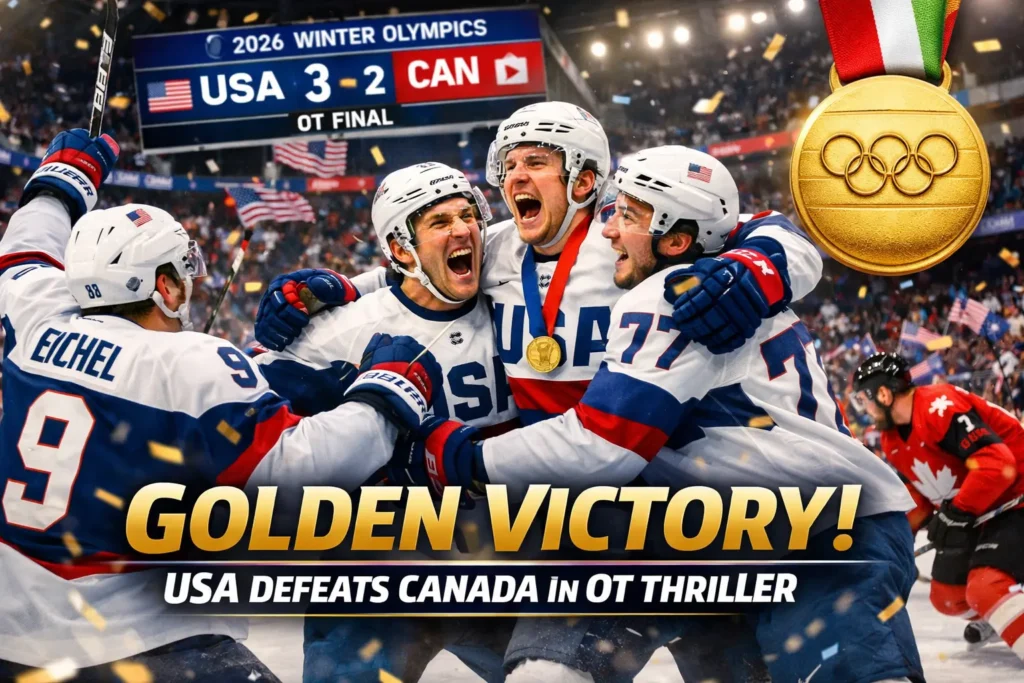
Early in the extra session, the United States capitalized on a transition opportunity. A controlled zone entry led to a precise shot that found the back of the net, ending the contest instantly.
American players leapt from the bench in celebration as the puck crossed the line. The goal secured gold and ended a 46-year wait for the nation’s men’s program.
The result will stand as one of the defining moments of the 2026 Winter Olympics.
What the Victory Means for Team USA
Ending a Historic Drought
The United States last won Olympic men’s hockey gold at the 1980 Winter Olympics in Lake Placid. That team’s victory over the Soviet Union and subsequent gold medal remains deeply embedded in American sports history.
By capturing gold in 2026, Team USA joins that legacy while establishing its own identity. The win demonstrates the program’s growth in player development, international competitiveness, and tactical sophistication.
A New Generation of Stars
Unlike previous Olympic cycles that featured amateur or mixed rosters, the 2026 tournament showcased elite-level talent competing at the highest international standard. The American roster blended experienced professionals with emerging stars, reflecting the strength of domestic and international development systems.
The victory is expected to inspire youth participation across the United States, particularly as hockey continues to expand beyond its traditional geographic strongholds.
Canada’s Performance and Perspective
For Canada, the overtime loss is a narrow setback in an otherwise strong tournament showing. The team displayed depth, speed, and resilience throughout the competition, reaffirming its position among the world’s top hockey nations.
Canadian officials and players acknowledged the intensity of the matchup and the thin margin separating victory from defeat. While the loss denies Canada another Olympic gold, the team’s performance underscored the continued competitiveness of its national program.
The USA-Canada rivalry remains central to international hockey, and this latest chapter adds further intrigue ahead of future world championships and Olympic cycles.
The Significance of Milan-Cortina 2026
The 2026 Winter Olympics, officially known as the Milano-Cortina Games, marked a return of the Winter Games to Italy for the first time since Turin 2006. Hockey was among the most anticipated events of the competition.
The gold medal final attracted widespread international coverage and strong viewership, reflecting the sport’s global appeal. The dramatic finish reinforced hockey’s status as one of the marquee events of the Winter Olympics.
Expert Reaction and Historical Context
Sports analysts described the overtime finish as a defining 2026 Winter Olympics moment. Many compared the emotional impact of the win though not the geopolitical context to the 1980 triumph.
Historians note that Olympic hockey has evolved significantly over the past four decades. Advances in training, analytics, and international competition have narrowed performance gaps between nations.
The 2026 final showcased how structured systems, depth scoring, and goaltending excellence now define championship-level hockey.
Statistical Snapshot of the Final
While the final score reflects a one-goal margin, underlying metrics illustrated just how balanced the contest was:
- Shots on goal remained close through regulation.
- Special teams conversion proved decisive in sustaining momentum.
- Faceoff wins were split evenly across periods.
The parity between the teams emphasizes how overtime hinged on execution in a single high-pressure sequence.
A Moment That Resonates Beyond the Ice
2026 Winter Olympics victories often carry cultural significance beyond sport. The United States’ 2026 gold medal win arrives at a time when international competition remains central to the Olympic spirit.
For American hockey fans, the victory provides a new reference point distinct from, but connected to, the legacy of 1980. For younger audiences, it may serve as their defining Olympic hockey memory.
The images of players celebrating on Italian ice are likely to endure as symbols of perseverance and teamwork.
Looking Ahead: The Future of Olympic Hockey
The 2026 Winter Olympics tournament reinforced the importance of maintaining elite participation in Olympic hockey. Competitive balance between nations enhances global interest and preserves the prestige of the event.
Both the United States and Canada are expected to remain contenders in upcoming international competitions. Development programs on both sides of the border continue to produce high-level talent capable of competing on the world stage.
As international hockey grows in Europe and Asia, future Olympic tournaments may feature even broader competition for medals.
Conclusion: A Historic Victory Rewrites the Narrative
The United States’ overtime victory over Canada at the 2026 Winter Olympics ends a 46-year wait for men’s hockey gold and reshapes the narrative of American Olympic hockey.
The win combines disciplined team play, tactical execution, and composure under pressure. It honors the legacy of past champions while defining a new era for the program.
For now, the image of Team USA celebrating in Milan-Cortina stands as one of the enduring highlights of the 2026 Winter Games a testament to the drama, rivalry, and global appeal that make Olympic hockey one of sport’s grandest stages.