
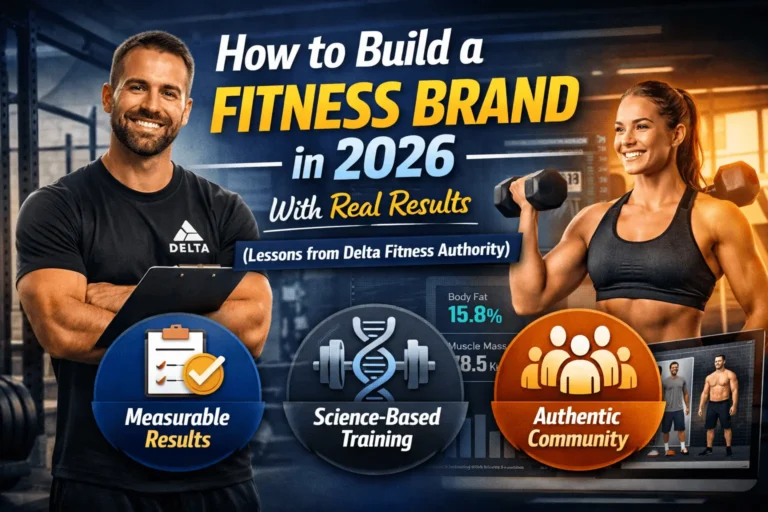
The Delta fitness authority industry in 2026 looks nothing like it did five years ago. New gyms open every month. Home workout apps multiply faster than protein shaker bottles. Social media floods with transformation stories.
Yet most gyms still struggle to stand out.
Members join. Members quit. Marketing budgets burn. Equipment sits idle.
The problem is not lack of demand. People still want stronger bodies, healthier lives, and better confidence. The real challenge is brand authenticity backed by evidence-based fitness.
This is where modern fitness brands learn from leaders like Delta Fitness Authority — a model built on measurable results, community trust, and science-driven programming.
Let’s break down exactly how to build a fitness brand in 2026 that delivers real results and earns real loyalty.
The 2026 Delta Fitness Authority Market: Crowded, Loud, and Competitive
According to IHRSA (International Health, Racquet & Sportsclub Association), global health club membership continues to grow, but retention remains a major challenge. Most gyms lose a significant portion of new members within the first six months.
Meanwhile, McKinsey’s wellness industry reports show rising demand for personalized, data-informed health services. Consumers now expect customization, transparency, and proof of effectiveness.
In simple terms:
- More competition
- Higher consumer expectations
- Less tolerance for empty promises
If your brand feels generic, you disappear.
If your brand proves results, you win.
Why Traditional Gym Branding No Longer Works
Old fitness marketing relied on:
- Cheap discounts
- Stock photos of ripped models
- “No pain, no gain” slogans
In 2026, that approach feels outdated. People have seen every six-pack ad on Earth. They don’t want hype. They want honesty.
Modern consumers ask:
- Will this program work for me?
- How do you measure progress?
- Is this approach backed by science?
- Can I trust this brand long term?
Brands that cannot answer these questions lose credibility fast.
Lesson 1: Build Your Brand Around Measurable Results
Delta Fitness Authority’s core principle is simple: results must be visible, trackable, and verifiable.
This reflects a larger industry shift. Research published in Sports Medicine Journal and PubMed-indexed exercise science studies confirms that structured, progressive, evidence-based programs lead to higher adherence and better outcomes.
A results-driven brand focuses on:
- Fitness assessments at entry
- Progress tracking dashboards
- Strength and conditioning benchmarks
- Body composition measurement
- Goal-based programming
This turns vague promises into concrete proof.
And proof builds trust.
Lesson 2: Use Evidence-Based Training, Not Fitness Trends
Trends come and go. Science stays.
Evidence-based fitness relies on:
- Progressive overload principles
- Recovery management
- Individualized programming
- Injury prevention protocols
Organizations like the American College of Sports Medicine (ACSM) publish globally recognized training guidelines. Following these frameworks adds credibility to your brand.
When a gym aligns its programs with established scientific standards, members feel safer, smarter, and more confident.
Bonus benefit: fewer injuries, better retention, stronger testimonials.
Lesson 3: Brand Authenticity Beats Perfect Marketing
Authenticity is not a buzzword anymore. It is a survival requirement.
Consumers in 2026 easily detect:
- Over-edited transformations
- Fake testimonials
- Overpromising headlines
Delta-style branding focuses on:
- Real member stories
- Transparent progress journeys
- Honest expectations
- Clear communication
Authentic brands don’t shout. They show.
A simple before-after story with verified data beats ten flashy ads with no proof.
Lesson 4: Build a Community, Not Just a Membership List
Harvard Health Publishing highlights that social support significantly improves long-term exercise adherence. People stick with programs when they feel connected.
Successful modern fitness brands:
- Create group challenges
- Celebrate milestones
- Encourage peer accountability
- Foster supportive coaching culture
Community transforms workouts into belonging.
Belonging keeps members paying.
And happy members become your best marketing team.
Lesson 5: Personalization Is No Longer Optional
Wearables, health apps, and AI-driven fitness tools exploded in popularity. Consumers now expect training plans that adapt to them.
Personalized fitness in 2026 includes:
- Heart rate-based programming
- Recovery tracking
- Adaptive weekly plans
- Lifestyle habit coaching
According to WHO physical activity guidelines, personalized and sustainable programs improve long-term adherence far more than generic routines.
Brands that personalize experience outperform brands that standardize everything.
Lesson 6: Coaches Must Be Educators, Not Drill Sergeants
Modern fitness coaching is not about yelling “one more rep.” It’s about guiding behavior change.
Research from Behavioral Science in Health Promotion shows that coaching focused on education and motivation improves consistency.
Delta-inspired coaching models focus on:
- Explaining why exercises matter
- Teaching correct movement patterns
- Supporting mental resilience
- Celebrating small wins
This creates trust-driven relationships, not transactional memberships.
Lesson 7: Content Marketing Must Educate, Not Just Sell
Google Discover prioritizes content that:
- Solves real problems
- Offers expertise
- Builds authority
- Feels human
Fitness brands that publish:
- Training explainers
- Recovery guides
- Nutrition basics
- Myth-busting articles
position themselves as trusted educators.
Educational content attracts organic traffic, builds credibility, and improves brand recall.
And yes it also reduces paid ad dependency.
Lesson 8: Data Transparency Builds Web Trust
In 2026, web trust signals matter more than ever.
Strong fitness brands:
- Cite reputable sources
- Reference established guidelines
- Avoid fake statistics
- Clearly explain methodologies
Trusted organizations you can safely reference include:
- American College of Sports Medicine (ACSM)
- World Health Organization (WHO)
- PubMed exercise science research
- Harvard Health Publishing
- IHRSA industry reports
Mentioning credible sources reassures both users and search engines.
Google rewards transparency.
Users reward honesty.
Lesson 9: Technology Enhances Experience, Not Replaces It
AI scheduling, smart check-ins, digital coaching dashboards, and wearable integration improve convenience. But technology should support humans, not replace them.
A successful fitness brand uses tech to:
- Track progress automatically
- Improve member communication
- Simplify bookings
- Offer hybrid training options
But real transformation still happens through human guidance, encouragement, and accountability.
Balance tech with human connection.
Lesson 10: Humor Humanizes Your Brand
Fitness is hard. People know it. A little humor lowers barriers.
Examples:
- “No, your dumbbells won’t judge you.”
- “Progress happens between reps, not overnight.”
Brands that feel human attract loyal audiences.
Just don’t overdo it. Friendly professionalism always wins.
How to Apply the Delta Fitness Authority Model
If you want to build a fitness brand that lasts beyond trends, follow this checklist:
- Define measurable result pathways
- Implement evidence-based programming
- Train coaches as educators
- Track progress transparently
- Build real community culture
- Offer personalized experiences
- Publish educational content
- Use trusted scientific references
- Balance technology and human care
No shortcuts. No gimmicks. Just consistency and clarity.
Video of Delta fitness authority
What Google Discover Wants From Fitness Brands in 2026
Google Discover favors content that:
- Solves user pain points
- Demonstrates expertise
- Feels fresh and engaging
- Provides real value
- Builds trust signals
When your brand content reflects:
Authenticity + Evidence + Results
Discover visibility follows naturally.
No keyword stuffing needed. Just smart, natural placement and helpful writing.
Final Thoughts
The future of fitness branding belongs to organizations that combine science with sincerity.
Delta Fitness Authority’s approach works because:
- It respects data
- It respects people
- It respects long-term growth
In 2026, fitness brands don’t need louder marketing.
They need better systems, honest messaging, and visible results.
Do that, and your brand won’t just survive the crowded market.
It will lead it.