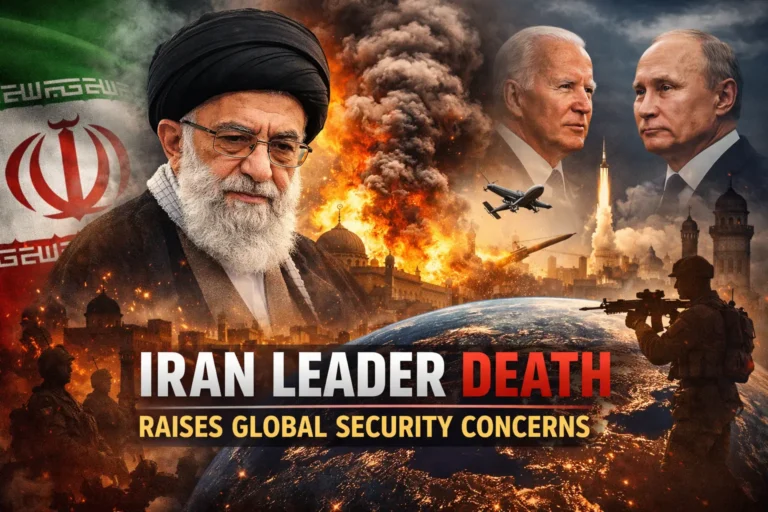
The Iran Leader Death in early 2026 has triggered one of the most serious geopolitical turning points of the decade. Governments, intelligence agencies, financial markets, and ordinary citizens across the world are now asking the same question: what happens next?
Iran confirmed the Iran Leader Death of Ayatollah Ali Khamenei, who ruled the Islamic Republic since 1989, following large-scale military strikes linked to escalating regional conflict. His passing instantly raised global security concerns, intensified diplomatic tensions, and opened an uncertain chapter for Iran’s political future.
This article explains what happened, why it matters in 2026, and how the event could reshape international stability using verified reporting and trusted sources while separating facts from speculation.
Table of Contents
Who Was Iran’s Supreme Leader and Why Iran Leader Death Matters
For more than three decades, Ayatollah Ali Khamenei stood at the center of Iran’s political system. Unlike presidents or parliament members, the Supreme Leader holds ultimate authority over:
- Military strategy
- Foreign policy decisions
- Nuclear negotiations
- Intelligence agencies
- Religious governance
He became Supreme Leader in 1989 after the Iran Leader Death of Ayatollah Ruhollah Khomeini and gradually consolidated power across Iran’s political and military institutions.
Simply put, removing Iran’s Supreme Leader is not like replacing a prime minister. It is closer to removing the core decision-making authority of an entire state system.
That explains why global reactions arrived within minutes not days.
What Happened: Confirmed Events Leading to the Iran Leader Death
According to multiple international news reports and Iranian state media confirmations:
- A major military strike targeted senior Iranian leadership positions near Tehran.
- Ayatollah Ali Khamenei was killed during the operation.
- Iran declared 40 days of national mourning shortly afterward.
- Officials warned of retaliation and vowed accountability.
Reports indicate the strike formed part of broader military escalation tied to disputes over Iran’s nuclear program and regional conflicts.
The announcement marked one of the most dramatic leadership losses in modern Middle Eastern history.
And yes global analysts immediately began calculating risk scenarios faster than traders check stock prices during market crashes.
Why the World Is Concerned: The Security Dimension
The phrase “global security concerns” is not political exaggeration. Several real risks emerged instantly.
1. Risk of Regional Escalation
Iran maintains influence across multiple regional actors and allied groups. Leadership disruption can trigger:
- retaliatory military actions
- proxy conflicts
- sudden escalation between rival states
Iran’s Revolutionary Guard warned of “severe punishment” following the leader’s death, signaling potential retaliation. (Moneycontrol)
In geopolitical terms, uncertainty often creates more danger than direct conflict.
2. Nuclear Policy Uncertainty
Iran’s nuclear program has long been a focal point of global diplomacy. The Supreme Leader historically held final authority over nuclear strategy.
With leadership transitioning:
- negotiation channels may freeze
- policy direction could harden or soften
- international monitoring faces uncertainty
Diplomats now face a familiar problem: negotiating with a system that is temporarily redefining itself.
3. Power Vacuum Risks Inside Iran
Iran’s constitution outlines succession procedures, but transitions are rarely simple.
Following the death, authorities formed an interim leadership council until a permanent successor is selected by the Assembly of Experts.
Power transitions can create competing factions, especially between:
- clerical leadership
- political institutions
- military organizations
History shows that unclear authority often invites instability not immediate collapse, but friction.
Domestic Impact Inside Iran Leader Death
While global headlines focus on geopolitics, the biggest impact may unfold inside Iran itself.
Public Reaction
Thousands gathered in mourning ceremonies across the country as the government declared nationwide observances.
Public responses appear mixed:
- loyalists frame the death as martyrdom
- critics question future governance direction
- younger populations focus on economic stability
Iran had already experienced economic protests and political tensions before 2026, making the transition period especially sensitive.
Economic Pressure
Iran’s economy faces long-standing challenges:
- sanctions pressure
- inflation
- currency volatility
Leadership uncertainty typically increases investor caution and market instability. Even oil markets reacted quickly to early reports, reflecting fears of supply disruption.
In global finance, uncertainty spreads faster than breaking news notifications.
Global Reactions: Diplomacy Enters Crisis Mode
World leaders responded cautiously.
Many governments avoided celebratory language and instead emphasized:
- regional stability
- restraint
- diplomatic dialogue
Why? Because sudden leadership removal in geopolitics rarely produces immediate peace. More often, it creates a period of strategic unpredictability.
International organizations began emergency consultations to prevent escalation and maintain communication channels.
What Happens Next: Iran’s Succession Process Explained
Iran’s political system includes a defined though complex succession structure.
Step 1: Interim Leadership
A temporary council now manages state affairs.
Step 2: Assembly of Experts Vote
A powerful clerical body selects the next Supreme Leader.
Step 3: Consolidation Phase
The new leader must secure support from:
- religious institutions
- security forces
- political elites
This phase often determines whether stability strengthens or fractures.
Think of it less as a simple election and more like a multi-layered negotiation happening behind closed doors.
Could This Change Iran’s Foreign Policy?
Analysts remain divided.
Possible Scenario A: Hardline Continuity
Iran’s system prioritizes institutional continuity. Policies may remain largely unchanged.
Possible Scenario B: Strategic Reset
New leadership might seek reduced tensions to stabilize the economy.
Possible Scenario C: Temporary Aggression
Transitions sometimes encourage strong external responses to project unity domestically.
Each outcome remains plausible and none can yet be confirmed.
Why 2026 Makes This Event Especially Significant
Timing matters.
The Iran Leader Death arrives during:
- heightened regional military tensions
- global energy market sensitivity
- shifting alliances between major powers
In earlier decades, such an event would still matter. In 2026’s interconnected world, its impact multiplies through instant information flow and economic interdependence.
One missile strike today can influence fuel prices, diplomacy, and cybersecurity discussions within hours.
Media, Misinformation, and the Information War
Another major concern involves misinformation.
Early reports varied widely before official confirmation a reminder that modern conflicts unfold simultaneously on:
- battlefields
- social media
- diplomatic channels
Verified reporting from established outlets remains essential to avoid panic or false conclusions.
In global crises, accurate information becomes almost as valuable as diplomacy itself.
The Human Side Often Overlooked
Behind geopolitical analysis lies a human reality.
Millions of Iranians now face uncertainty about:
- governance direction
- economic stability
- international relations
Leadership changes affect daily life from employment prospects to international travel restrictions.
While analysts debate strategy, ordinary citizens focus on practical questions: prices, security, and the future.
Global Security Outlook: Short-Term vs Long-Term
Short-Term Risks
- retaliation cycles
- military alerts across the region
- diplomatic tensions
Medium-Term Risks
- leadership competition
- nuclear negotiation delays
- regional proxy conflicts
Long-Term Possibilities
- policy recalibration
- new diplomatic openings
- structural shifts in Middle East alliances
History shows that major geopolitical transitions rarely resolve quickly. They evolve in phases.
A Logical Reality Check
It is tempting to assume that removing a powerful leader instantly changes a nation’s direction.
But political systems especially institutional ones rarely depend on one individual alone.
Iran’s governance structure includes multiple power centers that continue functioning even after leadership loss.
In other words: history rarely follows movie scripts, even when headlines feel cinematic.
Conclusion
The Iran Leader Death in 2026 represents more than a national event. It marks a pivotal geopolitical moment with implications for:
- Middle East stability
- global energy markets
- nuclear diplomacy
- international security strategy
The world now enters a period defined not by certainty, but by transition.
Whether this moment leads to escalation or opportunity depends on decisions made in the coming months by Iran’s next leadership, regional actors, and global powers alike.
For now, one fact remains clear: leadership changes at the center of geopolitical power rarely stay local. They ripple outward, reshaping global security conversations far beyond national borders.