
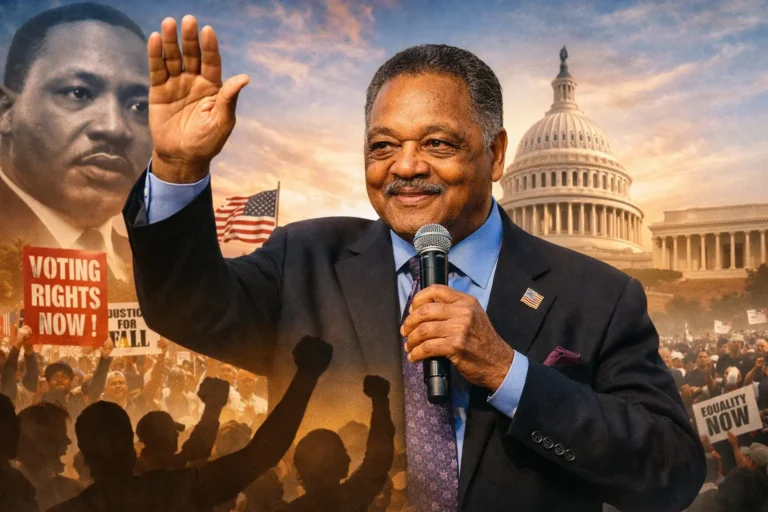
Veteran activist’s decades of advocacy continue to influence political, social, and community movements across the United States
CHICAGO, Ill. Civil rights leader Jesse Jackson remains a defining figure in the American struggle for racial equality, voting rights, and economic justice, even as new generations of activists take center stage. Known for his decades-long role in national politics and grassroots organizing, Jackson’s influence continues to shape conversations about democracy, opportunity, and social reform in 2026.
Jesse Jackson, now in his 80s, rose to prominence during the Civil Rights Movement of the 1960s and later became a two-time U.S. presidential candidate. His work has spanned voter registration drives, anti-poverty campaigns, and international diplomacy. While health challenges in recent years have reduced his public appearances, leaders across political and community organizations still reference his strategies and rhetoric as foundational to modern civil rights advocacy.
From Civil Rights Movement to National Leadership
Jackson first gained national attention as a close associate of Martin Luther King Jr., participating in major demonstrations and campaigns that pushed for the end of legalized segregation. After King’s assassination in 1968, Jackson emerged as a prominent voice advocating nonviolent protest, economic empowerment, and political participation for marginalized communities.
In the 1970s, he founded the Rainbow PUSH Coalition, a Chicago-based organization focused on social justice, education, and corporate accountability. The group’s initiatives ranging from scholarship programs to corporate diversity agreements helped institutionalize many of the movement’s goals within public and private sectors.
Jackson’s presidential campaigns in 1984 and 1988 marked a turning point in U.S. politics. Though he did not secure the Democratic nomination, his campaigns expanded voter participation and demonstrated the viability of a multiracial political coalition. Political historians frequently cite these efforts as precursors to later shifts in national electoral dynamics.
Continued Advocacy in a Changing Political Landscape
Even as public leadership roles evolved, Jesse Jackson maintained a presence in key national debates. He advocated for expanded voting access, criminal justice reform, and economic investment in underserved communities issues that remain central to policy discussions today.
Community organizers often reference Jackson’s emphasis on coalition-building and nonviolent engagement. Analysts note that his approach blended grassroots mobilization with institutional negotiation, allowing civil rights concerns to reach corporate boardrooms and federal policymakers alike.
Public figures from across the political spectrum have acknowledged his role in broadening civic participation. Scholars studying American social movements frequently describe Jackson as a bridge between the Civil Rights Movement and contemporary activism focused on systemic inequality.
Health Challenges and Reduced Public Appearances
In recent years, Jackson’s health has limited his travel and speaking schedule, prompting tributes and renewed reflection on his legacy. Supporters emphasize that his decades of advocacy reshaped national conversations about race, poverty, and representation.
Despite fewer public engagements, statements from civil rights organizations continue to highlight his symbolic and strategic importance. Events commemorating historic milestones of the Civil Rights Movement often include references to Jackson’s contributions, underscoring his long-standing presence in American public life.
Influence on Future Generations of Activists
Younger activists frequently draw inspiration from Jackson’s organizing model, particularly his focus on voter empowerment and economic justice. Educational institutions and policy forums still examine his speeches and campaign strategies as case studies in coalition politics.
Experts say this continued relevance reflects the unfinished nature of many civil rights goals. Issues such as voting access, income inequality, and educational opportunity remain central to national debate, reinforcing the enduring significance of leaders who helped bring those concerns into mainstream political discourse.
Jackson’s career also illustrates the evolution of protest into policy influence. By engaging both community movements and formal political systems, he demonstrated how sustained advocacy can translate into structural change an approach still studied by organizers and scholars today.
A Legacy Still Unfolding
As the United States navigates complex social and political challenges, Jesse Jackson life work offers historical context for ongoing reform efforts. His emphasis on inclusion, participation, and economic fairness continues to resonate in civic institutions and grassroots campaigns alike.
While the landscape of activism has shifted with new technologies and generational leadership, the principles Jackson championed remain embedded in contemporary movements. Observers say that enduring presence reflects not only personal achievement but also the persistence of the issues he spent decades confronting.
Video Source
Conclusion
Jesse Jackson influence extends far beyond the era in which he first rose to prominence. From marching alongside civil rights pioneers to shaping national political discourse, his career represents a continuous thread in America’s pursuit of equality and justice. As new leaders carry forward that mission, Jackson’s legacy endures as both historical foundation and ongoing call to action reminding the nation that the work of civil rights is never fully complete.