
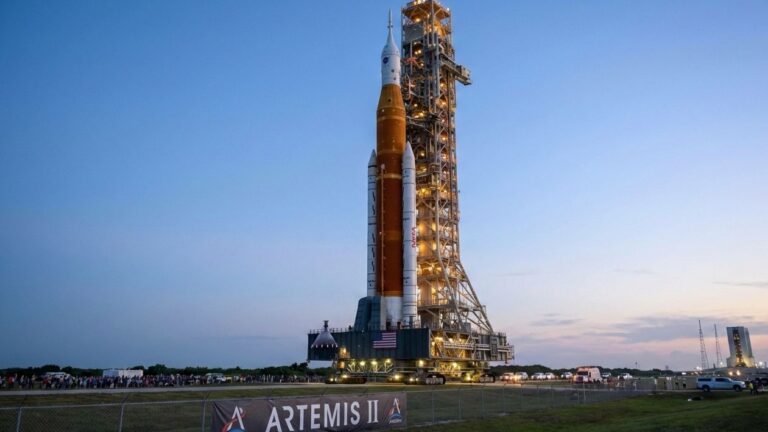
In anticipation of its first crewed lunar fly-around mission in over 50 years, NASA has relocated its Space Launch System rocket to the Kennedy Space Center launch pad. Launching as early as February, the Artemis II mission will take four astronauts on a ten-day orbit around the moon and back.
Canadian astronaut Jeremy Hansen and NASA astronauts Reid Wiseman, Victor Glover, and Christina Koch will board the 322-foot SLS rocket. The mission is an important step toward future crewed lunar missions planned under NASA’s Artemis program, even though the astronauts will not land on the moon. If it is successful, it will be the first time that people have visited the moon since 1972.
Due to past technical problems, the mission has been delayed for years. Before announcing an official launch date, NASA is anticipated to perform a wet dress rehearsal, a critical fuelling test, in early February. The mission would be postponed until March following a restricted launch window in February.
NASA Artemis II rollout and launch planning
On Saturday, NASA completed the last stage of preparations for the Artemis II mission by rolling the SLS rocket toward its launch pad in Florida. As hundreds of NASA workers, contractors, and relatives came to watch, the rocket emerged from the Vehicle Assembly Building at dawn and traveled approximately four miles to the launch pad at a speed of about one mile per hour on its mobile launch platform.
As the rocket approached the pad, Artemis II mission commander Reid Wiseman told Reuters, “We truly look at that and see teamwork, we see global cooperation, we see a strong nation leading the way.”
According to Reuters, Canadian astronaut Jeremy Hansen stated that the rocket “represents an extraordinary American workforce.”
After an unmanned test trip in 2022, Artemis II is the second mission in NASA’s multibillion-dollar Artemis moon program and the first to transport humans. Although the timeframe is dependent on the results of the wet dress rehearsal, which is held four days before to the intended launch, the mission is scheduled to launch as early as February 6.
Artemis launch director Charlie Blackwell-Thompson told Reuters that “wet dress is really the driver of the launch schedule” and that more time will be required to evaluate rehearsal data.
The launch of Crew-12, a different mission to the International Space Station that needs resources that overlap, might also have an impact on the February timeframe. In accordance with the orbital mechanics required for the lunar fly-around, Artemis II has several launch windows until April.
FAQs
Q1: What is the SLS rocket?
The Space Launch System (SLS) is NASA’s heavy-lift rocket designed to carry spacecraft, equipment, and eventually astronauts beyond Earth’s orbit. It is currently the most powerful operational rocket in the world.
Q2: Why was the rocket moved to the launch pad?
Moving the rocket to the pad means final launch preparations have started. Engineers will now conduct fueling tests, system checks, and countdown rehearsals before liftoff.
Q3: What is the purpose of the lunar flyby mission?
The lunar flyby mission is designed to send a spacecraft around the Moon and back to Earth. This tests deep-space navigation, life-support systems (in later missions), and re-entry safety before humans are placed onboard.
Q4: Is this a crewed mission?
This particular lunar flyby is uncrewed. It serves as a test flight to ensure all systems work safely before astronauts take part in future Artemis missions.
Q5: How tall is the SLS rocket?
The SLS rocket stands about 32 stories tall, making it one of the largest and most powerful rockets ever constructed.
Q6: What happens after this mission?
If successful, NASA will proceed with crewed Artemis missions, including orbiting the Moon and eventually landing astronauts on the lunar surface.
Q7: Why is returning to the Moon important?
The Moon serves as a testing ground for long-duration space travel, resource utilization, and technologies needed for future missions to Mars.
Q8: When will the launch happen?
The rocket’s move to the pad means the launch window is approaching, pending weather and final technical checks.