
You check the “Where’s My Refund” tool again. Still processing. Still no deposit. Still no joy. Waiting for a tax refund can feel like watching a loading bar stuck at 99%.
If this sounds familiar in 2026, you’re not alone. Millions of taxpayers rely on the official tracking tool from the Internal Revenue Service to monitor refunds each year. And every season, a large group sees the same frustrating message:
“Your return is still being processed.”
Let’s break down the real reasons this happens in 2026, what actually slows refunds, and the smartest fixes that help you get paid faster without myths, rumors, or fake timelines.
How the “where’s my refund” System Really Works in 2026
The official Where’s My Refund tracker updates once per day, usually overnight. Checking it 20 times before breakfast will not speed anything up though it may increase stress levels.
The IRS still follows a three-stage process:
- Return received
- Refund approved
- Refund sent
Most electronic filers receive refunds within 21 days, but that timeline only applies when:
- The return has no errors
- No identity or fraud review is triggered
- Credits like EITC or ACTC follow normal release timing
- Bank information is correct
If anything looks unusual, the return moves into manual review, which slows everything down.
Real Reasons Your Refund Is Still Processing
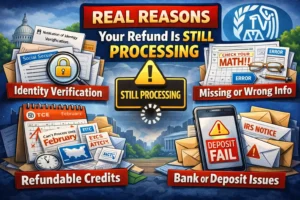
1. IRS Error Checks and Identity Verification
Fraud prevention has expanded in recent years. The IRS now runs stronger filters to stop identity theft and fake refund claims.
Common triggers include:
- Mismatched Social Security numbers
- New bank accounts not used before
- First-time filers claiming large credits
- Address changes across multiple states
When flagged, the return pauses until verification finishes.
This step protects taxpayers but it also delays refunds.
2. Errors or Missing Information on Your Return
Even tiny mistakes can stall processing.
Frequent issues in 2026:
- Wrong filing status
- Math errors in credit calculations
- Missing forms like 1099 or W-2
- Incorrect direct-deposit numbers
The IRS must correct or request clarification before issuing money.
That extra review adds weeks, not days.
3. Refundable Credits Still Cause Delays
Credits such as:
- Earned Income Tax Credit (EITC)
- Additional Child Tax Credit (ACTC)
require extra verification under federal law.
The IRS cannot release these refunds until mid-February at the earliest, even if you filed in January.
So yes your refund may be perfectly fine.
It just legally cannot arrive yet.
4. Paper Returns Move Much Slower
In 2026, electronic filing still dominates.
But paper returns continue to create long delays.
Manual handling means:
- Physical mail delivery
- Data entry by staff
- Longer review queues
Paper filers may wait six to eight weeks or more.
Sometimes longer during peak tax season.
5. IRS Backlogs Haven’t Fully Disappeared
Processing speed improved after pandemic-era delays, but seasonal backlogs still appear especially:
- Early February surge
- Late March deadline rush
- Returns requiring manual review
Even a modernized system cannot avoid volume spikes.
6. Bank or Direct Deposit Problems
Sometimes the IRS sends the refund on time.
But the bank slows things down.
Possible issues:
- Closed or frozen account
- Name mismatch with bank records
- Processing holds on large deposits
In these cases, the refund may bounce back to the IRS and convert into a paper check, adding weeks.
Smart Fixes That Actually Help in 2026
Let’s skip internet myths and focus on where’s my refund.
File Electronically With Direct Deposit
This remains the fastest, safest method.
E-file plus direct deposit consistently beats paper filing by weeks.
Tax software now checks for:
- Missing forms
- Calculation errors
- Credit eligibility mistakes
That prevention alone reduces delays.
Verify Identity Immediately If Asked
If the IRS sends a verification letter, act quickly.
Use the official identity verification portal or phone instructions.
Delays often happen because taxpayers wait too long to respond.
Fast response = faster where’s my refund.
Double-Check Bank Details Before Filing
One wrong digit can send your refund into limbo.
Before submitting:
- Confirm routing number
- Confirm account number
- Ensure the account accepts deposits in your name
Two minutes of checking can save two months of waiting.
Track Notices, Not Rumors
Social media loves refund rumors.
The IRS loves official letters.
If your status stays frozen, watch your mailbox for:
- Verification letters
- Correction notices
- Review explanations
Ignoring notices is one of the biggest real-world causes of long delays.
Contact Help Only When Timing Makes Sense
Calling the IRS too early won’t help.
Representatives usually cannot act until:
- 21 days after e-file, or
- 6+ weeks after paper filing
Before that window, they see the same status you see.
For serious hardship or extreme delay, the independent Taxpayer Advocate Service may help resolve issues faster.
What Refund Timing Looks Like in 2026
While exact dates vary each year, typical patterns remain:
- Early filers without credits: fastest refunds
- Credit claimants: mid-February or later
- Manual review cases: several extra weeks
- Paper returns: longest wait times
Understanding these patterns reduces stress and prevents unnecessary panic.
Signs Your Refund Delay Might Be Serious
Most delays are normal.
But a few warning signs deserve attention:
- Status unchanged for more than 6 weeks
- IRS letter requesting documents
- Refund amount suddenly different
- Identity theft notice
These situations require direct follow-up, not patience alone.
How to Avoid Refund Delays Next Year
Smart taxpayers treat refund speed like a system, not luck.
Build a Faster Filing Routine
- Gather documents early
- File electronically
- Avoid last-minute rushing
- Review entries carefully
Accuracy beats speed but accuracy also creates speed.
Consider Adjusting Withholding
A huge refund may feel exciting.
But it also means you gave the government an interest-free loan all year.
Many taxpayers now adjust withholding to:
- Increase monthly paycheck
- Reduce refund size
- Lower processing anxiety
Smaller refunds usually arrive faster and smoother.
The Emotional Side of Waiting for a Refund
Let’s be honest.
This isn’t just about paperwork.
For many households, a tax refund means:
- Catching up on bills
- Paying rent
- Covering emergencies
- Finally breathing easier
So when the status says still processing, frustration makes perfect sense.
The key is knowing the difference between:
- Normal delay
- Problem requiring action
Knowledge reduces stress faster than refreshing a webpage.
Video Source
Final Thoughts : where’s my refund
Seeing “still processing” in 2026 feels scary.
But in most cases, it simply means the IRS is:
- Checking accuracy
- Preventing fraud
- Managing seasonal volume
And yes… moving slower than anyone would like.
The good news:
Most refunds still arrive.
Just not always on your preferred timeline.
Stay patient.
Watch official notices.
Act quickly if verification is needed.
And maybe just maybe stop checking the tracker every five minutes.
Your refresh button deserves a break too.